
I last attempted to calculate the carbon footprint of myself and my immediate family back in 2021 when we were living in our old house. I used a free Henkel carbon calculator tool which unfortunately no longer exists, so I couldn’t use it to update my results now that we’ve moved house. I also couldn’t find a good (free) tool online that would capture our current lifestyle, so instead I used a mish mash of different tools to try to calculate my footprint as accurately as possible.
These are my overall results:
| tonnes CO2 emissions/year/person OLD HOUSE | tonnes CO2 emissions/year/person* NEW HOUSE | |
| Housing | 1.4 | 0.4** |
| Transport | 0.6 | 0.5 |
| Food | 2.2 | 2.0 |
| Consumption/hobbies | 0.3 | 1.6 |
| TOTAL | 4.5 | 4.5 |
**Estimated for the year based on information on the EPC and 9 months worth of electricity bills and water bills.
Calculation process:
Home
The energy use in our new house is much lower than our old house despite it being almost twice the size. Our old house was 150m2, over 100 years old and had been renovated quite extensively by the previous owner to an EPC C rating. In 2021 we used 3,600kwh of electricity and 8,900kwh of gas. The Henkel tool then added on some emissions based on the size of our house and our approximate water use (I estimated the number of times we used our dishwasher/washing machine and shower per week), to give a total of 1.4 tonnes of CO2/person/year.
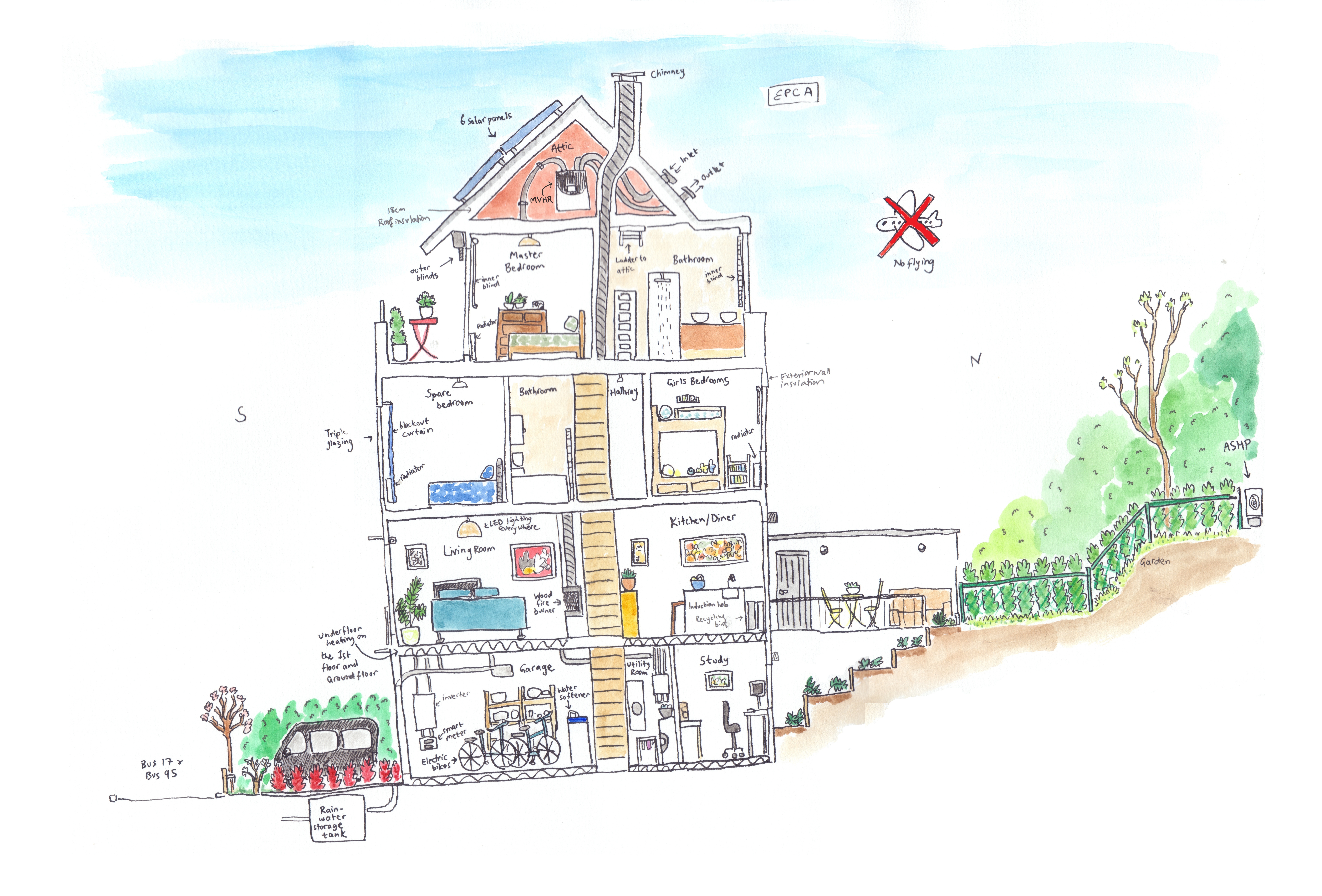
By comparison the construction of our new house was finished in July 2024, and it has an EPC rating of A. It’s ~260m2, highly insulated, triple glazed, has a mechanical ventilation system with heat recovery, LED lighting and is powered by an air source heat pump and solar panels. We’ve also installed a mix of internal and external blinds to lower solar gains during the summer, so hopefully we will not need to use electric fans for cooling very much. The house is glazed on the facades facing North and South which also helps to minimize solar gains (our old house had most of the glazing on the façade facing West so it got very hot in the late afternoon), and we’ve installed moustiquaires on the windows of the girls bedroom and our bathroom that overlook the garden, so its quiet enough to open the window during the night without letting in insects to enable night-cooling.
I estimate that we will use about 5,600kwh of electricity from August 2024-August 2025 (and zero gas!) and we will generate approximately 2,520kwh per year with our 6 solar panels on the roof. The house does also have a wood fire burner which I have no idea how they got planning permission for as they are so polluting and completely unnecessary in an A rated home with an ASHP and underfloor heating. We haven’t used it and have no intention of using it.
Our total electricity usage is 5,600-2,520 (from the solar panels)= 3,080 kWh. In Belgium the emissions per kWh on average in 2024 were 0.11 kg/kWh (data from Nowtricity), so that gives us a total of 0.08 tonnes CO2/person/year for our home energy use.
Our water use I’ve estimated as 30m3 per person per year and have used an emission factor of 10.6 kg of C02/m3/year for processing and distribution (from this research paper) . That adds on 0.32 tonnes/C02/year for our home emissions.
I have not included any embedded CO2 emissions from the construction of the house.
Transport
Our transport emissions look as though they have dropped slightly, but I think this is only because of the different calculation method as our usage has not really changed.
We still have the same petrol car (a Touran) and we still drive it approximately 10,000km a year. Our day to day use has gone down slightly with the house move as we now live closer to my husbands work. He’s also in general cut down on driving to work because the house is larger and there is more space for him to comfortably work from home (we used to get in each others hair a lot!) 1-2 days a week, and he also takes public transport to and from work 1-2 times per week now as the new house is much better connected with tram and bus stops very close by. However, we are driving a bit further for holidays and leisure activities as the girls can handle longer periods in the car. I used an emission factor of 0.145g/km from this site which means we have emissions of 0.36tonnes of CO2/person /year for our car use.
We don’t fly and still haven’t gotten into taking long distance rail journeys with the kids.
I’ve added on emissions from the ferry’s we have taken and are planning to take this year using this site (0.06 tonnes/person/year), and emissions from our bus and rail use using the carbonfootprint.com calculator (0.02 tonnes/person/year).
For short journeys on my own I use my electric bike (I have a fear of driving so I’m never tempted to use the car unless there is a medical emergency). I always charge it at home, so the electricity usage of this will be included in our home emissions.
Food
Again it looks as though our food emissions have dropped, but we haven’t made any big changes to our diet. This is because the carbonfootprint.com tool I used puts restaurant meals in with ‘Hotels, restaurants and pubs etc’ rather than in the ‘Food’ category as the Henkel tool did, so these emissions are now included in my ‘Consumption/hobbies’ category.
We still eat what I would regard as a ‘low meat eater’ diet, with minimal beef and no lamb. I drink almond milk/oat milk instead of dairy milk and try to choose fish or vegetarian options when we eat in restaurants. I’m obsessive about minimizing food waste, and the waste we do create we either put in the municipal food waste collection or the local shared compost if it’s vegetable peelings or coffee grounds. We try to buy organic as much as possible, but I haven’t got into reducing food miles and don’t tend to check where things are grown. We rarely get takeaways, but do eat out quite a lot when we are on holiday.
Consumption/hobbies
This is the area in which our emissions have gone up the most.
This is in part because the carbon footprinting tool I used to calculate the emissions for my Consumption/hobbies carbonfootprint.com included a lot more items in what it calls ‘secondary activities’ than the Henkel tool did for consumption/hobbies. For example it also includes emissions from pharmaceutical purchases, telephone and mobile use, sporting and recreational activities as well as financial products like mortgages.
We’ve also changed our behaviour and recently started spending more money on Kinderhotels for our holidays which are all inclusive, whereas in 2021 during Covid times we only went to a few self-catered places within Belgium. We are also eating out more more generally as the girls have gotten older and its easier to do. Our consumption of furniture has also gone up with the move to a bigger house. My husband and I have joined quite a nice gym nearby to the new house and so our spending on recreation (and corresponding emissions) has gone up.
Our consumption of clothes and books remains low as we still get them second-hand for the most part, and we try to limit our consumption of toys and gadgets, although that seems to be getting harder as the children get older and are more demanding! We still don’t have any pets (which can be surprisingly high carbon if they eat meat).
We recycle diligently, and pass on items that are still useful to friends or family or by using the neighbourhood app Hoplr.
CONCLUSION
Our overall carbon footprint hasn’t dropped despite there being quite a large drop in our housing emissions (1 tonne C02/person/year) with the move to an all electric, highly insulated home that’s partially renewably powered.
This is partly because I’ve had to use a different carbon footprint calculation tool that includes more items (so hopefully it’s now a more accurate picture of our emissions), and partly because we are eating out more and going to more all inclusive hotels than we did before (twice a year instead of not at all).
(As a quick check of my results to see if they are in the right ballpark, I had a look at what our results would be using the OCE carbon calculator which doesn’t collect such detailed information. They gave me an overall carbon footprint of 4.208 tonnes/year, which is very similar to my result).
At 4.5 tonnes of C02/person/year we are well below the UK average of 12.7 tonnes per year (according to ‘How bad are bananas?’ by Mike Berners-Lee) while still living a very comfortable lifestyle. However, there is of course still more work to do to get down to 2.5. tonnes of CO2/person/year by 2030 to have a lifestyle in line with keeping global warming to 1.5 degrees. (I recently did a Coursera course on mainstreaming 1.5 lifestyles which I would highly recommend which is where I got this target from – see their citizens guide for more info. The target is for everybody world wide so is a fair distribution of emissions and means people living in poverty can increase their current emissions to enable them to have more comfortable lives).
FUTURE PLAN:
This is where I think we could make the cuts from over the next 4 and half years:
| tonnes CO2 emissions/year/person NEW HOUSE | tonnes CO2 emissions/year/person 2030 | |
| Housing | 0.4* | 0.3 (-0.1) |
| Transport | 0.5 | 0.1 (-0.4) |
| Food | 2.0 | 1.4 (-0.6) |
| Consumption/hobbies | 1.6 | 0.8 (-0.9) |
| TOTAL | 4.5 | 2.5 |
Housing emission cuts:
I think as the house is already at an EPC A rating and we try to minimize our energy use by turning off lights and appliances we are not using (and unplugging them when we are away on holidays) and we don’t use a dryer, there are not many improvements we can make to reduce our energy consumption. I’m hopeful that we won’t need to resort to air-conditioning by 2030, as although the likelihood of heatwaves hitting Belgium is going up, the design of the house should keep the temperature bearable inside. Worst-case scenario in a prolonged heatwave we can all sleep in the study on the ground-floor which is partly underground and stays quite cool.
I’m also hopeful the amount of renewables in Belgium will increase and so the emission factor of electricity production will reduce from 110 g/kWh, but given they may reduce their nuclear energy output as the nuclear power plants in Belgium age and go offline it may actually go up.
I think we can reduce our water consumption though by connecting the rain water tank (which collects the water that falls on our roof) underneath our driveway to our water supply .This will cost about 1000 euros to make the connection and install a pump. The rainwater can then be used in our toilets, washing machine and for the external tap which we use to water the garden.
We planted quite a lot of new plants this spring (including 16m of hedge) and there has been a drought in Brussels, so to keep the plants alive we’ve been watering quite regularly. Droughts are forecast to happen more often here in spring with climate change, but hopefully once the plants have bedded in they will be able to withstand them better and we won’t need to water them quite so much in future years. We’re also going to ‘rewild’ nearly a third of the lawn so it should also be more resilient to drought.
Our younger daughter should transition soon to taking showers instead of baths every two days, so that will also cut down on our water consumption. We already use the eco settings on the washing machine and dishwasher to keep water consumption low for these items.
I’ve assumed a 40% drop in our water consumption from these changes to give us a reduction in the emissions associated with water purifying and delivery of 0.1 tonnes CO2/person/year.
Travel emission cuts
As we don’t fly we use the car for long journeys to go on holiday. We bought the car in 2019 so probably just before 2030 we will replace it, with the aim being to buy an electric car with a long range battery and quick charging time.
Before we do this, as the kids are getting older and need less paraphernalia and can handle waiting at stations, I think we can start to try going on holiday by train instead of car and ferry. I’m also hoping I can convince my husband to stop driving to work altogether. Our elder daughter should hopefully by 2030 be able to use public transport by herself and be more independent so there will also be less need to be her taxi service.
Depending on how successful these changes are we may or may not replace our car with an electric car- if we are hardly using our car by that point then we may be able to get rid of it entirely and use an electric car-share service when we do want to drive somewhere.
I’ve estimated a 90% drop in our car use and 100% drop in car ferry use, but an increase in international rail use to 8000km/year (which is maybe too high!). This gives us a drop in emissions of 0.4 tonnes CO2/person/year.
Food emission cuts
I’ve assumed a switch to a mainly vegetarian diet by 2030 and corresponding reduction in emissions of 0.6 tonnes/person/year, but it’s going to be tough to convince the rest of my family. I think I could do it relatively easily if I was on my own, but cooking two separate meals most evenings and adding on stress to family meal times which can be quite fraught because of how fussy the kids are is not something I want to do! Our diet does need to change though from our current restricted 8 meals in rotation that the two kids will actually both accept (all of which contain a small portion of meat but no beef or lamb) and so my aim is to gradually slip in vegetarian meals to the mix.
There are some local community farm projects near us, so I’m also going to sign up to a weekly vege box delivery to decrease our food miles.
Consumption/hobbies emission cuts
The cuts here I think we could make by cutting down even further on buying new clothes and switch to almost all second hand (-0.13 tonnes/person/year), and by cutting down completely on buying new furniture and only buying second hand if necessary (-0.06 tonnes/person/year). We can also stop going to all inclusive Kinderhotels which have been a bit of a guilty pleasure, but now the kids are older and holidays are a bit less intense self-catered is fine (-0.4 tonnes/person/year). Finance wise we’re planning on paying back the mortgage as fast as possible and keep savings in Triodis bank which is supposedly more sustainable (-0.27 tonnes/person/year). This gives us a total of 0.86 tonnes of C02/person/year in cuts.
FINAL REFLECTIONS:
This exercise has been useful, but a little bit daunting. I guess I had been hoping that with the move to our new eco-friendly house we would have bought ourselves a bit of time before we needed to make any other big lifestyle changes to keep on track to be living a 1.5 degree compatible lifestyle, but because my original calculation missed out some areas of our lifestyle emissions and the global situation is only getting worse and carbon capture projects are failing, there’s not much time to pause, I need to keep going!
It’s also hammered home to me how necessary acting on EVERYTHING matters – travel/food/consumption/our homes – we don’t get to make trade-offs between eating meat, or flying, or driving a petrol car, or having an energy inefficient home, given the carbon budget that we have left we have to not do any of them if we want a fair distribution of emissions and to minimize the damage that we bake in.
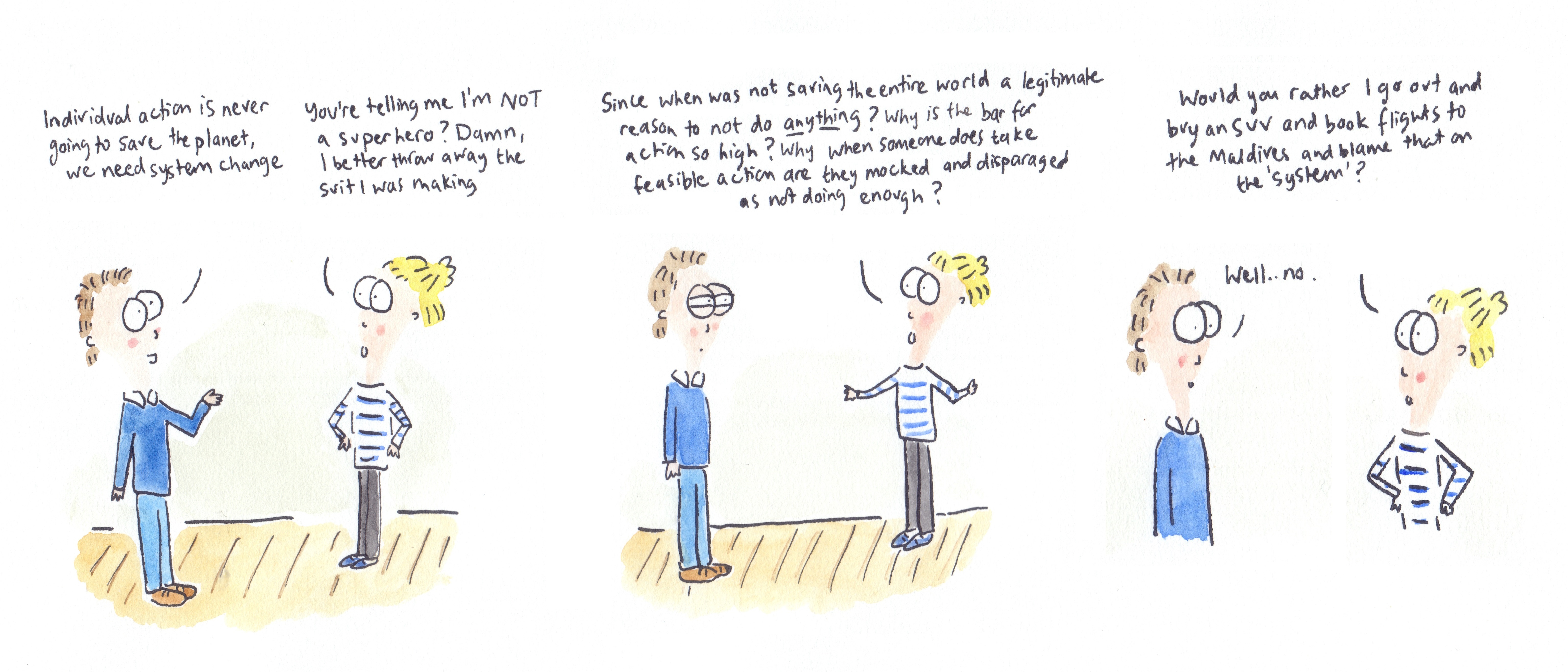
It’s hard not to get demotivated sometimes- why should I keep trying to make changes when there are so many people with means who so clearly are not trying in the slightest (flying multiple times a year, driving an SUV, spending tens of thousands renovating their house without making changes to the energy consumption etc etc), but holding on to the idea of fairness and knowing that if I reduce my emissions enough somebody else who lives in poverty has the carbon-budget to increase their emissions enough to have a fulfilling life helps. I’m also lucky to live near a forest and go walking there regularly which keeps me connected to nature and means I don’t constantly want to fill a void with consumption and travel, I have what I need. Making changes has also been very positive- because our new house is so well insulated it’s very warm and comfortable, moving closer to public transport will enable our kids to be more independent when they are teenagers (which will hopefully keep them off their phones!), I love cycling and it’s great exercise, flight-free travel means I never have to deal with airport security or lost baggage or a jet-lagged toddler. I know that making further changes will be beneficial too- eating less meat will cut my risk of cancer and assuage my guilt of knowing how terrible the welfare conditions are of farm animals. Whilst living a low carbon lifestyle gets framed as a sacrifice there are so many benefits even on an individual level and even in the current system that we live in that it seems silly not to when you have the means to do so.
 laratheescapeartist
Leave a comment